This guide walks through each step in the order you’ll actually do them. No fluff, no “here’s what you’ll learn” preamble. Just the specs, decisions and sequence that get a book published.
Key takeaways
- Niche specificity wins: “Woodland animals for toddlers” outperforms “animals” on both KDP and Etsy because it matches what buyers actually search for.
- Copyright is a hard rule: Free printable sites generally limit their pages to personal use. Only original art, or AI-generated art from a tool that grants you commercial rights, is safe to sell.
- Format matters as much as art: The most common KDP trim size for coloring books is 8.5 × 11 inches; if your art runs to the edge, submit at 8.625 × 11.25 inches with bleed. KDP asks for 300 DPI images, embedded fonts and flattened layers.
- Price at $9.99 or more on KDP: On Amazon.com, paperbacks priced at $9.99 and up earn a 60% royalty rate (before printing costs); at $9.98 and below it’s 50%.
- Catalog size is the growth lever: Ten niche-specific books build compounding organic traffic in a way a single title can’t.
- Your listing does the selling: The cover image is the biggest lever for clicks in a crowded search results page. A keyword-rich title, a specific niche and a description that answers “is this the right difficulty for me?” turn those clicks into sales.
What actually makes coloring book pages sell?
One coloring book gets 200 reviews. Another in the same category gets zero. Success often depends more on style, niche specificity, complexity and copyright-safe art than on raw technical skill. Getting any one of these wrong quietly kills the listing before it gets a chance.
Style and complexity: match the level to your audience. The coloring page market runs a wide spectrum. At one end are simple bold outlines with thick lines and minimal detail for toddlers and beginners: kids coloring sheets a four-year-old can fill without frustration. At the other end are intricate mandala-style pages with layered geometric patterns that adults use as a mindfulness activity. Mandalas dominate adult search traffic, while animals dominate the kids’ category. Buyers are remarkably specific about difficulty in their reviews and searches, so a book that falls between the two satisfies neither audience.
The practical move is to commit to one end of the spectrum per title. An adult relaxation book should have enough detail to hold attention for 30 minutes. Mixing difficulty levels in one book is a common mistake that leads to vague listings and confused buyers.
Niche specificity: why “animals” loses to “woodland animals for toddlers”. Broad topics get buried on KDP and Etsy under thousands of competing titles. The coloring book pages that actually sell are hyper-specific: cozy café scenes, kawaii food characters, holiday-themed dinosaurs, breed-specific dog books. In 2026, the strongest demand is anchored to animals (especially dinosaurs, cats and unicorns for kids), mandalas for adult relaxation, seasonal holidays for traffic spikes, and rising themes like cozy, kawaii and fantasy. Each of those has sub-niches that are far less crowded than the top-level category.
One useful benchmark for KDP: a niche is worth entering when at least three top results have a Books ranking under #100,000 and at least two competitors have 50 or more reviews. That combination signals real demand without an impossible level of competition. Capybara books and construction-vehicle books for young children fit that profile, according to 2026 niche data from Midas Tools, a KDP analytics and niche research platform.
Copyright-safe art: the mistake that gets sellers delisted. This matters more than most new creators expect. Trademarked characters are the obvious trap, but the subtler one is using art from free printable sites as a starting point. Free coloring sites typically allow their pages for personal or classroom use only. Selling a derivative of their pages, even heavily modified, puts your seller account at risk and exposes you to takedown notices.
The only clean path is original art, or AI-generated art from a tool that grants you commercial rights, with no trademarked characters in it. When you publish on KDP, you’re also asked whether the book contains AI-generated images: for AI-drawn pages and covers, the answer is yes.
How to generate coloring book pages with AI
AI has collapsed the production timeline for coloring book pages from weeks to minutes. The old workflow meant commissioning an illustrator, waiting on revisions, formatting pages by hand, designing a cover separately, then exporting different files for each platform. The new workflow does most of that in one session.
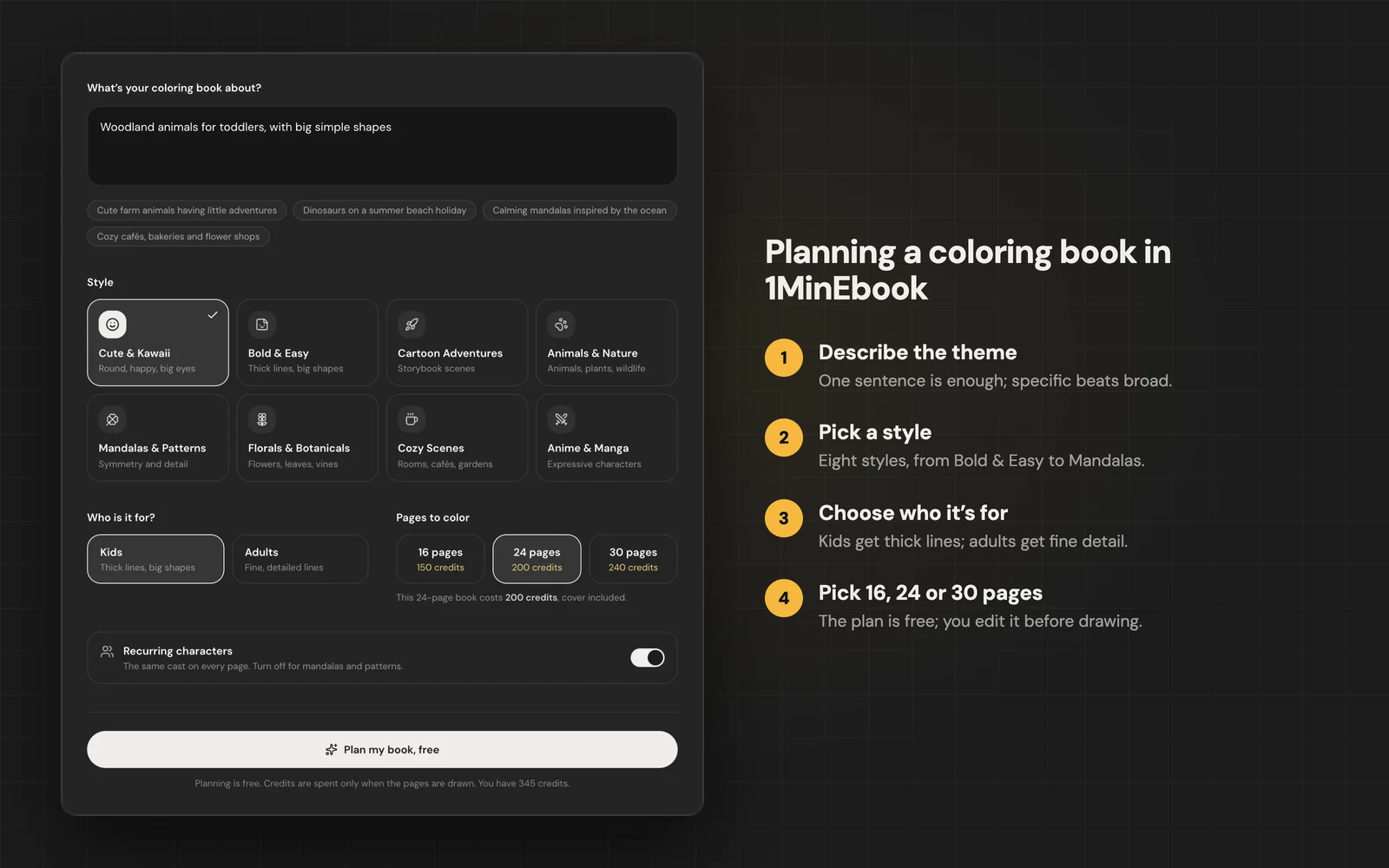
Using 1MinEbook to plan, draw and export a coloring book in one place. 1MinEbook’s coloring book maker handles the whole pipeline. You describe your theme, pick one of eight styles (from Cute & Kawaii and Bold & Easy to Mandalas & Patterns and Cozy Scenes), choose kids or adults, pick 16, 24 or 30 pages, and decide whether the same characters should appear on every page. It plans the book for free: a title, a back-cover blurb and one scene per page, all of which you can edit. Then it draws every page as clean black-and-white line art at print resolution, paints a full-colour cover and builds the files:
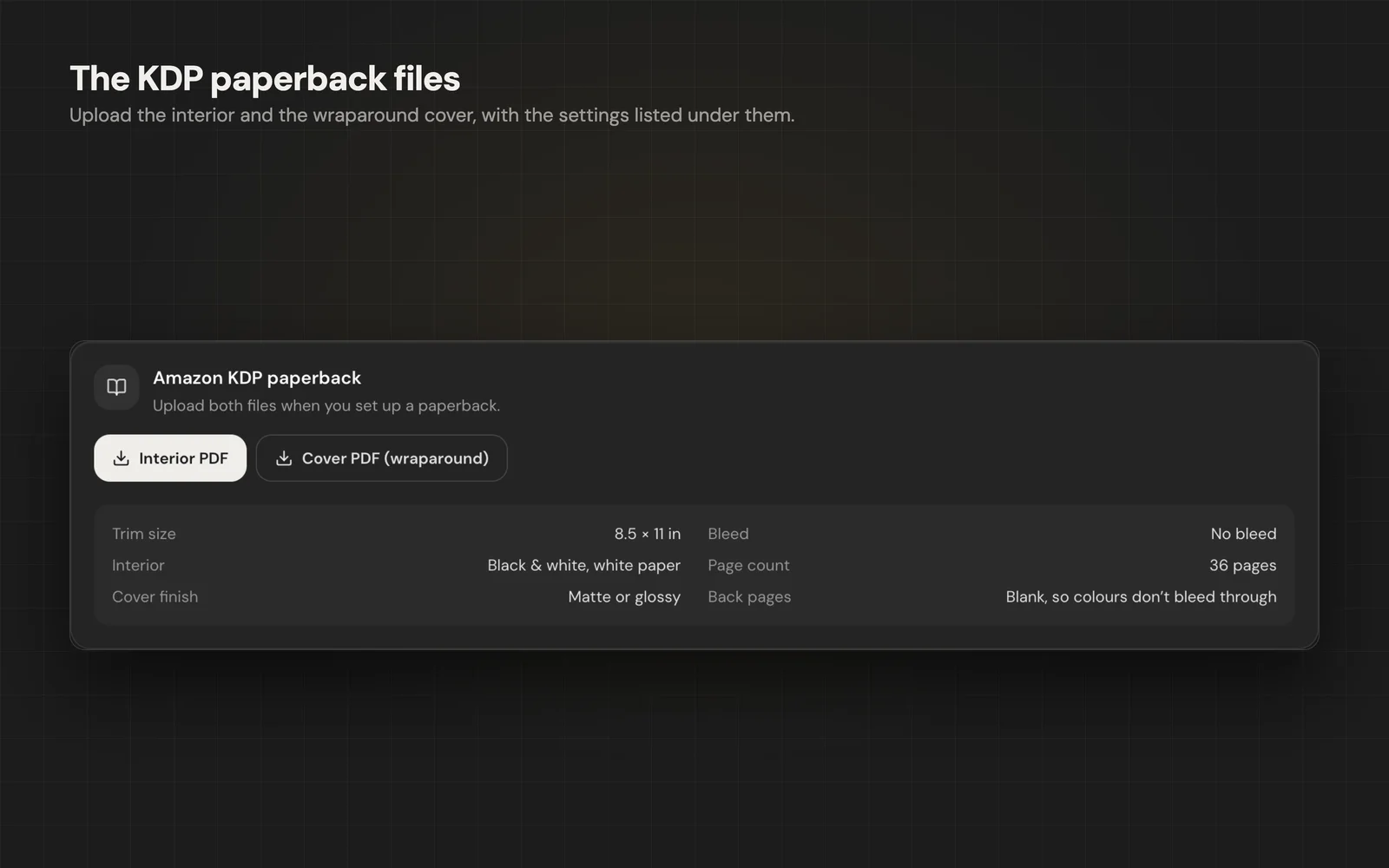
- KDP paperback interior: 8.5 × 11 in, no bleed, every drawing on its own right-hand page with a blank back, so markers don’t bleed through.
- Wraparound cover PDF: back, spine and front with bleed, the spine sized to your page count.
- Printable PDF: Letter size, one drawing per page, for home printing and Etsy.
- Front cover image: 2,550 × 3,300 px for your listing.
The copyright question from the previous section is answered here: every plan includes full commercial rights, with no royalties and no revenue share. You can sell the book on KDP, list the printable pages on Etsy, bundle them with other titles and price everything however you want. That’s the difference between an AI tool built for commercial publishing and free printables from a coloring site.
Planning a coloring book is free. Drawing it uses 150 credits for 16 pages, 200 for 24 and 240 for 30, cover included, and downloads come with any paid plan.
Which 2026 themes are worth building right now. Pick the theme before you generate, not after. The niche decision shapes everything: the cover style, the listing keywords, the difficulty level and even the page count. Mandalas for adult relaxation and animals for kids are the two highest-volume categories, but they’re also the most competitive. The better entry points are one level down: cozy bold-and-easy adult pages, breed-specific pet books, dinosaurs with a twist (dinosaurs at school, dinosaurs in vehicles), and seasonal books timed for holiday traffic. Fantasy, witchy and dark-academia themes are also growing as lower-competition adult niches worth testing in 2026.
Getting coloring book pages set up right: dimensions, bleed and margins
Beautiful pages formatted to the wrong spec get rejected by KDP or look unprofessional in print. This is the part most tutorials skip or bury at the end, and fixing formatting after the fact is slower than getting it right the first time.
Standard dimensions for KDP and Etsy print files. For US-market coloring books on KDP, the most common trim size is 8.5 × 11 inches. It’s what buyers expect in the category, and it’s where most competition data and niche research are anchored. KDP supports other trim sizes too; see KDP’s trim size, bleed and margins guide for the full list.
For Etsy digital downloads, format your printable sheets to US Letter (8.5 × 11) as the main file, with an A4 version as a bonus for international buyers. Sellers report that offering both sizes in one listing raises perceived value and buyer satisfaction.
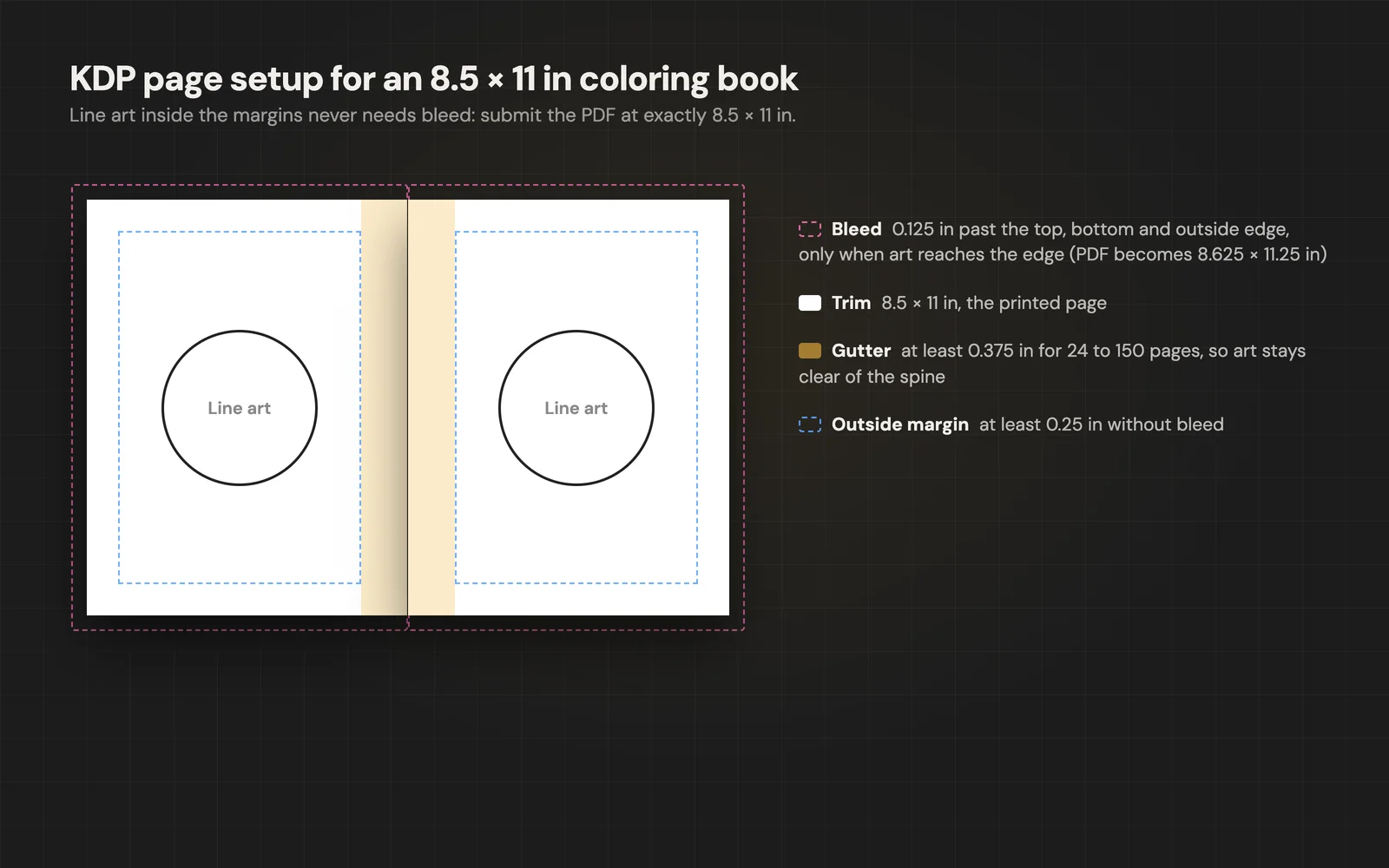
What bleed, margins and safe zones actually mean. Bleed is extra space added to your PDF so that when the printer trims the page to its final size, there’s no white gap at the edge. On KDP, that means adding 0.125 inches to the top, bottom and outside edge of each page, so an 8.5 × 11 page with bleed is submitted as an 8.625 × 11.25 inch PDF. If your line art stays inside a white border and never reaches the edges, skip bleed entirely and submit at exactly 8.5 × 11.
The safe zone, or inside margin, keeps your line art from disappearing into the spine. KDP requires at least 0.375 inches on the gutter for books of 24 to 150 pages. Keep important artwork farther from the gutter than the minimum, because printing tolerances aren’t perfect and binding shifts the visible area slightly.
Paper and printer settings for the best print quality. For proofs, or copies you sell at markets, the practical all-purpose setup is 24 to 28 lb matte white paper, printed in grayscale at Actual Size (100%) and single-sided. Crayons work fine on 20 lb copy paper. Colored pencils benefit from slightly heavier, subtly textured stock that handles repeated layering. Alcohol markers need 160 to 200 gsm cardstock or dedicated marker paper to prevent bleed-through. For KDP interiors, choose a black and white interior: it keeps outlines clean and avoids processing issues during upload.
How to list on Amazon KDP and Etsy: what actually works
Getting the file right gets you to the starting line. The listing is what turns a searcher into a buyer. They’re two distinct skills, and treating them the same is why most new coloring book sellers plateau after their first title.
Formatting your interior file for each platform. KDP wants a single PDF with embedded fonts and no spreads (pages submitted one by one, not as two-page layouts), up to 650 MB, with images at 300 DPI at the printed size. Flatten transparency and layers before export, because unflattened files can render unpredictably; PDF/X-1a is a safe standard if your software offers it. For Etsy digital downloads, PDF is the norm, though buyers also accept PNG and JPEG for single-page designs. Anything meant for home printing should still be 300 DPI.
What makes a coloring book listing convert? Three elements do most of the work. The cover image drives click-through; it’s the biggest lever in a crowded search results page. The title should lead with the main buyer keyword and include the audience and style in a way that sounds like a real book title, not a string of search terms. A strong KDP title looks like “Cozy Cottagecore Coloring Book for Adults: Relaxing Forest, Garden, and Mushroom Scenes.” A strong Etsy title leads with the primary keyword, includes “printable” or “instant download” if accurate, and uses the pipe-separated format buyers recognize: “Kids Dinosaur Coloring Pages | Bold and Easy Printable PDF | Instant Download.”
The description answers one question: is this the right book for me? Say who it’s for, what subjects are included, how many pages, the style (bold and simple, or intricate) and what the buyer receives. KDP descriptions work well at 150 to 300 words with short paragraphs and bullets. For Etsy digital listings, state the file types, dimensions, paper sizes included and printing expectations, and use terms like “printable coloring sheets” and “coloring book printables” where they fit naturally. Hiding single-sided printing or personal-use restrictions in the fine print leads to the kind of negative review that sinks a listing faster than any algorithm change.
How do you test a niche and scale your coloring book income?
One book is a product. Ten books with a validated system is a catalog. The creators building real income from coloring book pages treat it like a business from the start, validating a niche cheaply before committing to a full interior.
The fastest validation method is a manual search on Etsy and KDP. Look at the review counts on the top-selling titles in your niche. A healthy niche has consistent sellers with 50 to 500 reviews: not zero, which suggests no demand, and not 50,000, which suggests the window has closed for new entrants. Check the “also bought” patterns to find adjacent sub-niches worth testing, such as a printable bundle on a related theme. Then put out a small test book before committing full production time.
On pricing: most standard KDP coloring books sell for $6.99 to $9.99, but the royalty math makes $9.99 the default starting point for adult books. On Amazon.com, paperbacks priced at $9.99 or more earn a 60% royalty rate, while those at $9.98 or less earn 50%, in both cases before printing costs.
On Etsy, digital downloads are priced differently: a 30 to 60-page PDF of adult coloring printables sits comfortably at $7.99 to $12.99, while themed mega-bundles of 80 to 200 printable pages can reach $24.99. The real scaling lever is catalog size. With an AI workflow, production time per title shrinks, and the constraint shifts to niche selection, which is exactly the work that needs human judgment. For more on pricing and marketplaces, see how to price your ebook and how to sell on Etsy.
Start with the niche, then ship the book
Creating sellable coloring book pages with AI isn’t a shortcut that replaces thinking. It removes the production bottleneck so the thinking can actually happen. Pick a specific niche. Generate your pages and cover with a tool that gives you commercial rights. Format to KDP or Etsy spec. Write a listing that says what the buyer actually gets. Publish it. Then test another niche.
The most useful reframe is this: you’re not trying to make one perfect coloring book. You’re building a system that lets you publish validated niche products faster than the competition. The creators winning in this space aren’t the most artistically skilled; they’re the ones who treat niche selection seriously and keep shipping.
If you haven’t tried it yet, start a coloring book on 1MinEbook with one specific niche and one audience, and commit to getting the first title live before optimizing anything. Niche research and listing copy are where the real work is, and both are skills that compound with every title you publish.
Frequently asked questions
Are these coloring pages printable? Yes. Whether you publish on KDP or sell printables on Etsy, the files are print-ready PDFs at 300 DPI. Buyers can print them at home on standard US Letter paper or take them to a local print shop. For Etsy listings, offering both US Letter and A4 versions covers the widest range of home printers.
Can I sell AI-generated coloring book pages? You can, as long as the tool you use grants full commercial rights and the pages don’t include trademarked characters or licensed imagery. 1MinEbook’s plans include commercial rights with no royalties and no revenue share, which makes it a clean option for publishing on KDP and Etsy. On KDP, declare AI-generated images when you publish, and always check the rights terms of any AI tool before listing for sale.
What’s the best trim size for a KDP coloring book? 8.5 × 11 inches, the same as US Letter. It matches what most buyers expect and what most niche research for the category is based on. If your art reaches the edge of the page, submit with bleed at 8.625 × 11.25 inches.
How many pages should a coloring book have? Most single-theme KDP coloring books run from 30 to 60 pages, and 50 is a common benchmark that balances perceived value with production time. Drawings should be printed on one side only, so 24 drawings make a 52-page paperback once the title, copyright and blank backs are counted. On Etsy, buyers expect digital downloads to give similar or more pages for less than print, since there’s no printing cost.
Make your first coloring book
Describe your theme and pick a style. 1MinEbook plans every page for free, then draws them and builds a KDP-ready interior and wraparound cover.
Make my coloring bookPlanning is free · KDP-ready interior and cover